
Articles
Types of Bearings: A Complete Guide
GCr15, 52100, 100Cr6, and SUJ2 are close in chemistry but not identical — here's what actually separates them on a material certificate.
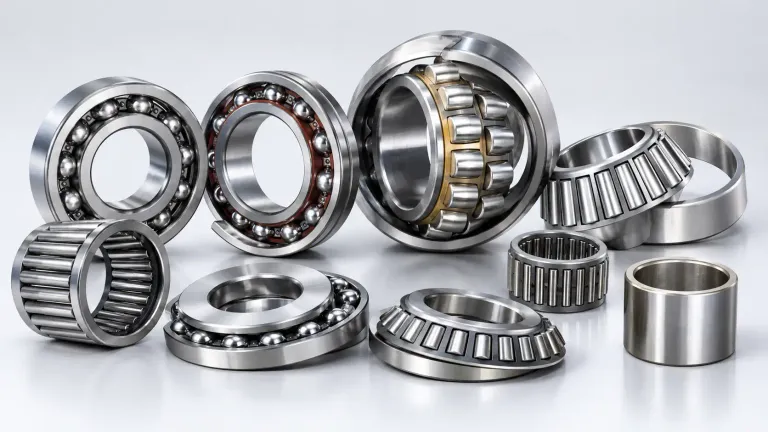
What Are the Main Types of Bearings?
Bearings split into two broad families: rolling bearings and plain bearings. Rolling bearings use balls or rollers between the rings to cut friction, and they break down further by rolling element shape. Plain bearings drop the rolling elements and let the shaft slide on a bushing or an oil film. Within the rolling family, the types most engineers and buyers reach for are deep groove ball, angular contact ball, self-aligning ball, thrust ball, cylindrical roller, spherical roller, tapered roller, needle roller, and thrust roller bearings. The choice comes down to load direction, load magnitude, speed, and how much shaft misalignment the machine can tolerate.
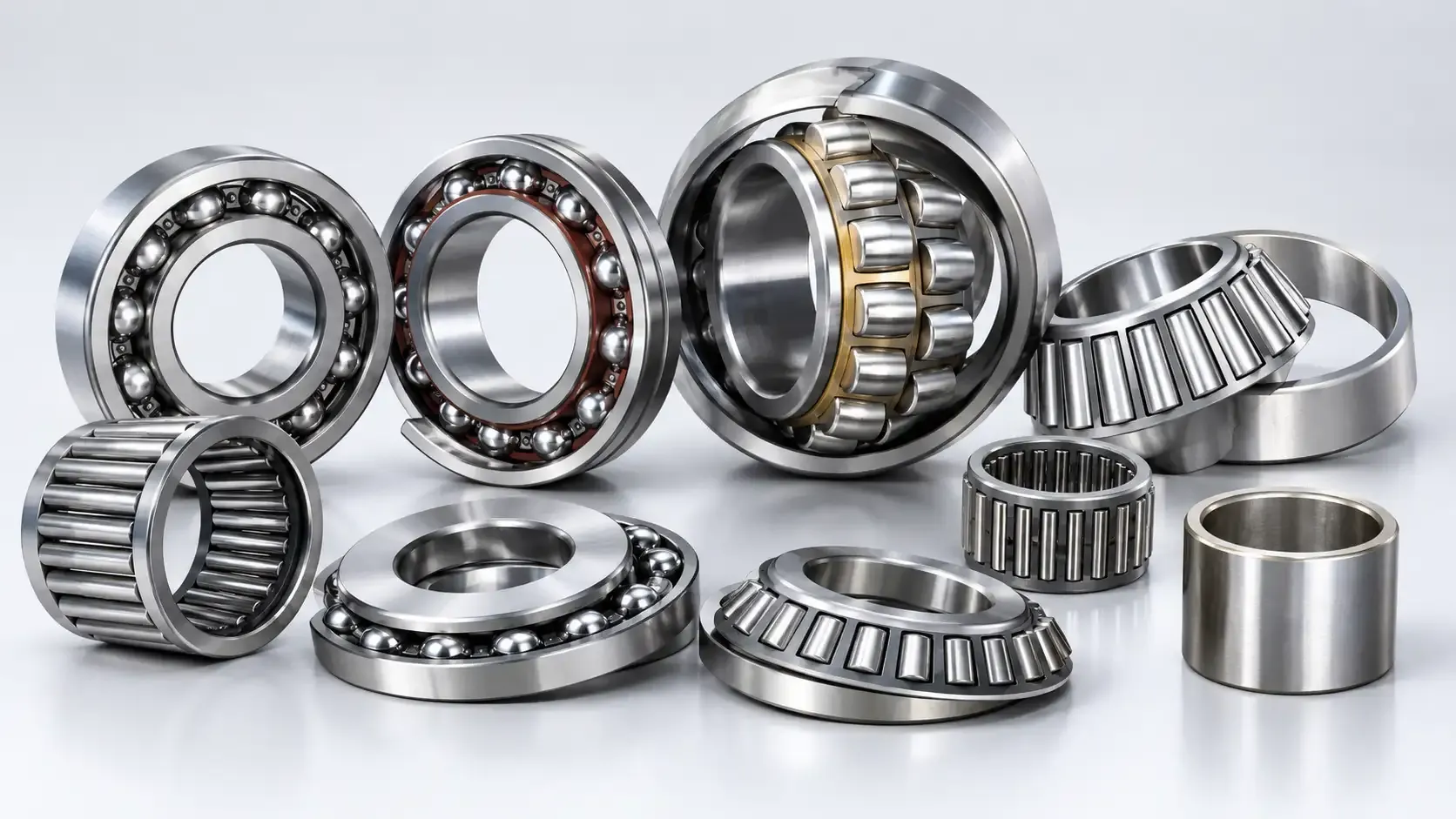
Start With Point Contact vs. Line Contact
Most selection mistakes trace back to one physical fact. A ball touches its raceway at a point, so friction and heat stay low but the load concentrates on a tiny area. A roller touches along a line, spreading the same load over far more contact area. That is why ball bearings run fast with moderate load, and roller bearings carry heavy load at lower speed. It sounds obvious, but it is the thing nobody states clearly enough: a bearing type is almost never interchangeable across families, even when the bore and outside diameter match.
Before reading further, keep this in mind. The list below is ordered the way a design conversation usually runs, from the default general-purpose choice outward to specialist types.
Deep Groove Ball Bearings: The Default
If nothing special is demanded, this is the answer. A deep groove ball bearing takes radial load plus a modest axial load in either direction, runs at high speed, and costs less than anything else in its size. That is why electric motors, fans, pumps, and household appliances all run on them.
The groove in the inner and outer rings is slightly deeper than the ball radius, which is where the name comes from, and it lets the bearing carry that small bidirectional thrust without a separate thrust element. Sealed versions use 2RS rubber seals or ZZ metal shields, and the suffix tells you which. In a motor, C3 internal clearance is the usual choice because the inner ring runs hotter on the shaft and expands into the clearance.
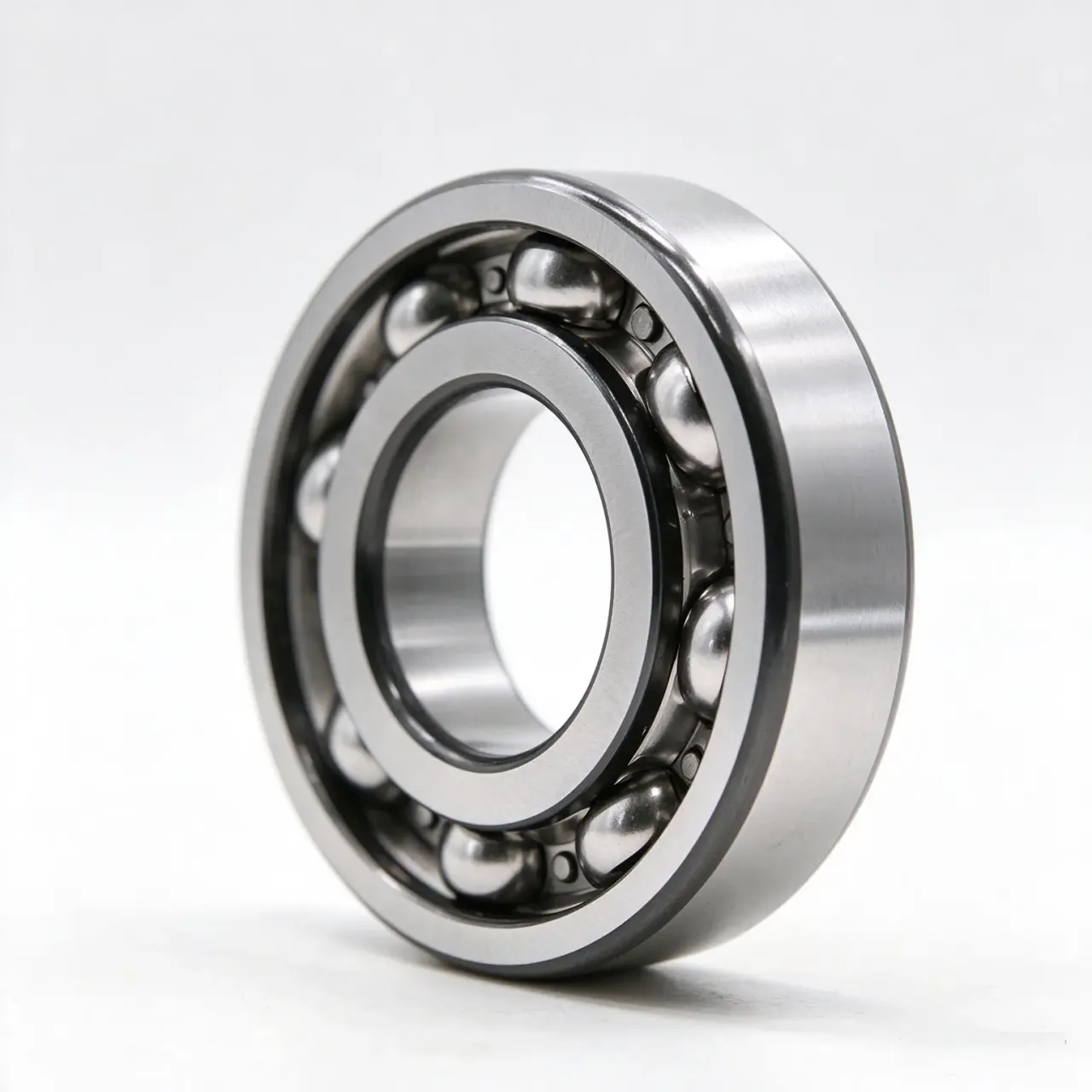
Angular Contact Ball Bearings: Combined Load, One Direction
When there is real axial load alongside radial load, or the shaft must be held stiffly, an angular contact ball bearing carries it. The raceways are offset so the contact line sits at an angle to the radial plane, and that contact angle is what gives the bearing its thrust capacity. The trade is that it takes axial load in one direction only, which is why these bearings almost always run in pairs, back-to-back or face-to-face.
This is the machine-tool spindle and pump choice. The contact angle is often written as a suffix, and getting it wrong on an order is a common shipping error.
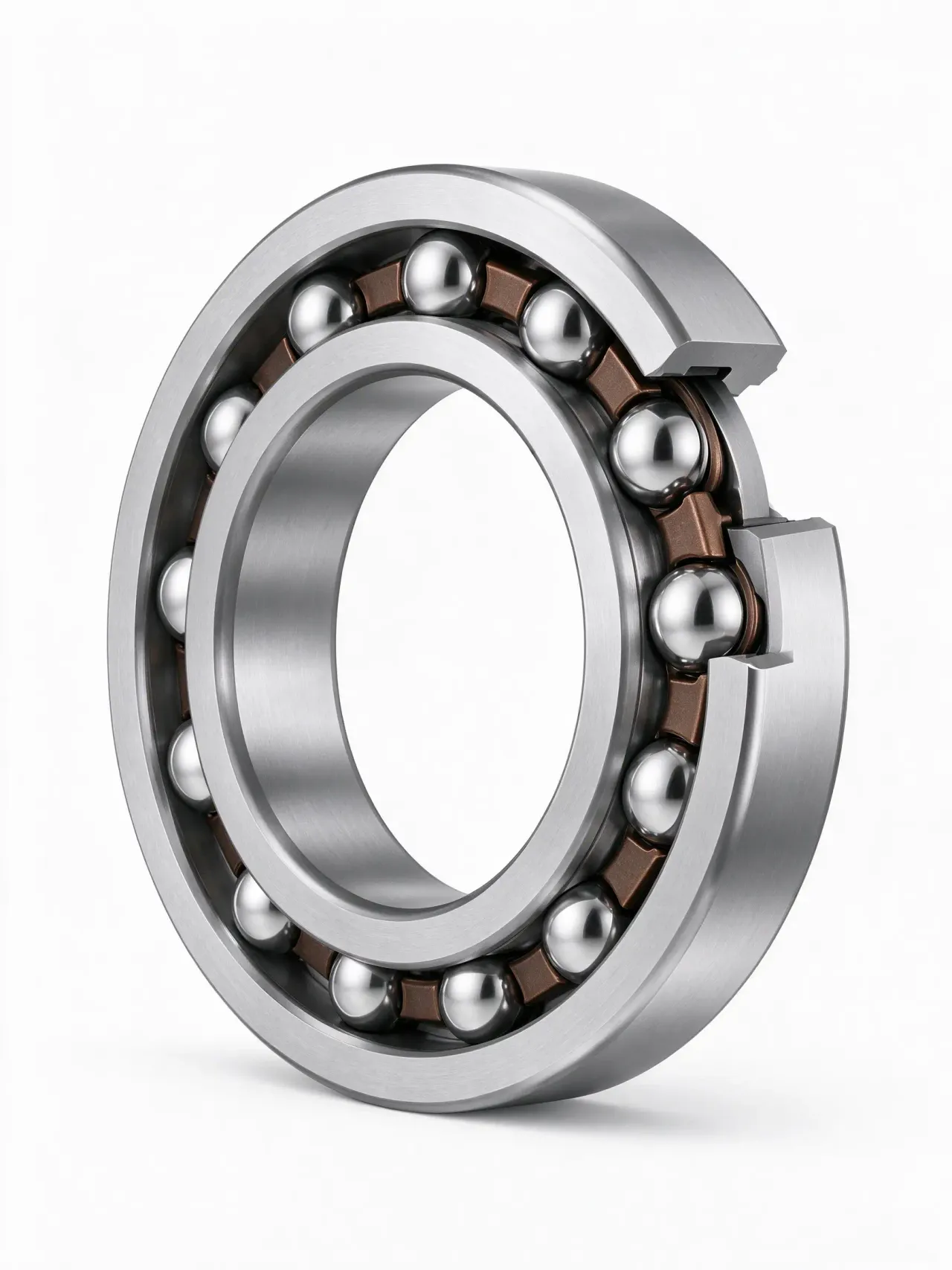
Self-Aligning Ball Bearings: For Shafts That Will Not Stay Straight
Sometimes the shaft is going to deflect or the housing is not going to line up, and no amount of careful assembly fixes it. A self-aligning ball bearing puts a spherical outer raceway under the balls so the inner ring can tilt a few degrees without overloading the raceway edges.
This is the long-shaft, agricultural, and conveyor choice, and it is usually the difference between a bearing that survives a mounting error and one that fails early. It does not match a deep groove bearing's speed or a roller bearing's load, but it forgives what those two cannot.
Thrust Ball Bearings: Pure Axial, Low Speed
A thrust ball bearing is built to take axial load only, and it takes essentially no radial load. That narrow job means it runs at low speed, because the balls want to spin out under centrifugal force at higher rpm. You find it under vertical shafts, crane hooks, and screw jacks. If the machine needs axial load at speed, this is not the bearing, and pushing it there is how thrust ball bearings fail early.
Cylindrical Roller Bearings: Heavy Radial at Speed
When a ball bearing runs out of radial capacity but speed still matters, a cylindrical roller bearing is the next step. The line contact carries far more radial load on the same envelope, and these are among the faster roller types. The NU, NJ, NUP, and N letter prefixes decide how the bearing locates the shaft axially, which is not cosmetic. Some designs separate so the inner and outer rings mount independently.
Spherical Roller Bearings: Load Plus Misalignment
A spherical roller bearing runs two rows of barrel-shaped rollers on a spherical outer raceway, which means it carries very heavy radial load, some thrust, and tolerates a shaft that is not perfectly aligned. No ball or cylindrical bearing of the same size self-aligns. This is the mining, crusher, vibrating screen, and heavy industrial choice, and the W33 suffix marks an outer-ring lubrication groove with oil holes for relubrication in service.
Tapered Roller Bearings: Combined Load From Both Directions
A tapered roller bearing runs conical rollers on conical raceways, and the geometry means it handles heavy radial and heavy thrust at the same time. The cup and cone are separable parts, and the inch and metric series do not mix. This is the wheel hub and gearbox workhorse, and like angular contact bearings it is almost always set in opposed pairs because a single row only locates in one direction.
Needle Roller Bearings: Radial Load in a Thin Ring
When radial load is high but there is almost no room for the bearing's outside diameter, a needle roller bearing packs long, thin rollers into a very small radial section. It carries no thrust and runs at moderate speed, but it fits where nothing else will. Gearboxes, universal joints, and oil pumps are full of them.
Thrust Roller Bearings: The Heavy Axial Column
A thrust roller bearing is the roller answer to the thrust ball bearing's speed limit. Line contact gives it far more axial capacity, and the spherical roller thrust version adds a little self-alignment. This is the bearing under a vertical motor, a pump's axial load, or a heavy rotating column.
Plain Bearings: No Rolling Elements at All
A plain bearing removes the balls and rollers entirely and lets the shaft slide on a bushing, a sleeve, or an oil film. It is cheap, compact, quiet, and good at absorbing shock, and the cost is friction. It suits low-speed, high-load, or oscillating points such as hinges, linkages, and large slow-turning shafts. Within this family, a spherical plain bearing handles angular oscillation, and a cylindrical plain bearing, or sleeve bushing, handles pure rotation.
How to Pick a Bearing Type
The fastest path is to resolve the constraints in a fixed order rather than starting from a favorite part. Load direction first, then load size, then speed, then space, then misalignment. Each step narrows the field, and skipping the first step is how a bearing ends up running hot or wearing early.
Constraint | What to Ask | Typical Result |
Load direction | Radial, axial, or combined? | Radial → deep groove or cylindrical; axial → thrust; combined → angular contact or tapered |
Load size | Light, moderate, or heavy? | Light to moderate → ball; heavy → roller |
Speed | High or low? | High → ball or cylindrical; low and heavy → spherical or tapered |
Space | Tight radial section? | Needle roller or plain |
Misalignment | Shaft deflection expected? | Self-aligning or spherical |
This table is a starting point, not a universal specification. Confirm every choice against the load rating, speed limit, and fit for the actual part number, because the catalog data is where the real decision gets made.
Match the Type, Then the Supplier
Once you have narrowed the field to a bearing type, the rest is confirming the catalog data for the specific part — load rating, speed limit, clearance, seals, and fit — against what your machine actually sees. The type gets you to the right family; the part number gets you to a bearing that will last.
At Luoyang Fonyo Heavy Industries Co., Ltd. (FONYO), we manufacture ball bearings and roller bearings across these families, from deep groove and angular contact through spherical, tapered, and cylindrical roller types. Tell us the load direction, speed, and envelope, and we will help you confirm the type and the part number before you commit to an order.
FAQ About Bearing Types
Which bearing type is most common? Deep groove ball bearings, by a wide margin. They cover the largest share of general-purpose rotation because one design takes radial load, light thrust, and high speed at the lowest cost.
What is the difference between ball and roller bearings? Point contact versus line contact. Ball bearings touch the raceway at a point, so they run fast with moderate load. Roller bearings touch along a line, so they carry heavier load but run slower and generate more friction.
When should I use a self-aligning bearing? When shaft deflection or housing misalignment is unavoidable, such as on long shafts, agricultural equipment, or conveyors. A self-aligning ball or spherical roller bearing forgives angular error that would overload a rigid bearing's raceway edges.
Are bearing types interchangeable if the dimensions match? No. A same-size bearing of a different type is a different machine element. The dimensions may fit, but the load direction, speed limit, and misalignment tolerance do not, and the wrong type fails early.
What is the W33 suffix? W33 marks a spherical roller bearing with a lubrication groove and oil holes in the outer ring, which lets lubricant reach the rolling elements and simplifies relubrication in heavy equipment.
Do I need a thrust bearing for axial load? Sometimes. A deep groove bearing already takes light bidirectional thrust. You only need a dedicated thrust ball or thrust roller bearing when axial load is the dominant load and radial load is small or absent.